Charlie Fink started playing the guitar when he was a young man. He started writing songs when he was a little older. He discovered the concepts of love, death and time shortly after this and soon could think about little else. The remainder of his formative years Charlie spent with his ears inside headphones recording his own songs or listening to musicians with similar preoccupations.
The words and sounds of Dylan, Young and Wilson changed Charlie’s frame of reference. Charlie obsessed about their sense of narrative and their scale, and their ability to combine wit and seriousness. With the proliferation of computer systems, Charlie discovered closer contemporaries. He soon felt empowered by the honesty, immediacy and authenticity of Bonnie ‘Prince’ Billy, Neutral Milk Hotel, Daniel Johnston and Jeffrey Lewis.
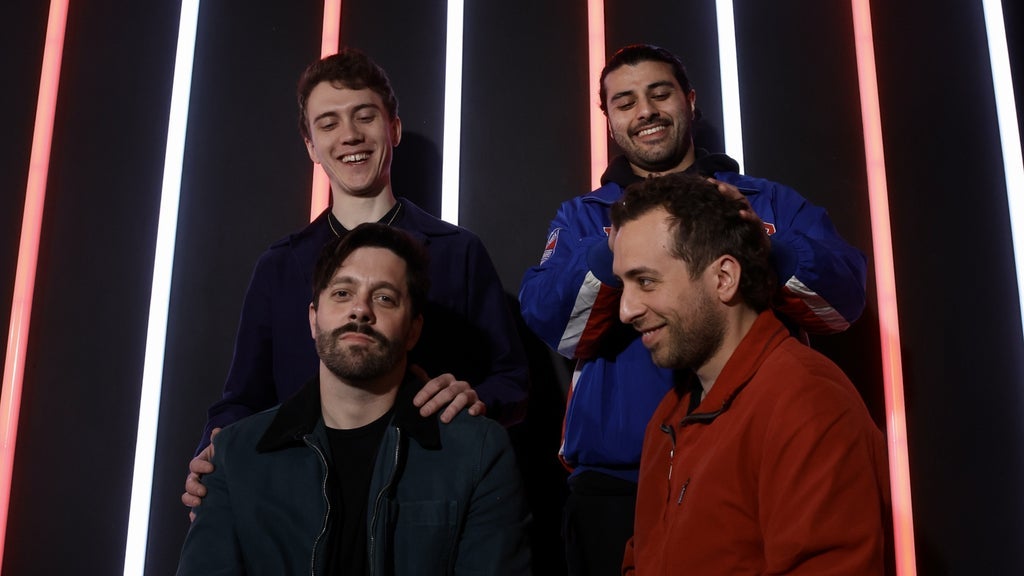
Eventually it occurred to Charlie that his compulsion to expel in song his deep-set morbid anxieties might serve some public purpose. Initially he ventured forth beyond his gravel drive on his own. Soon however, Charlie decided that he better have his brother Doug on board otherwise he might get lonely and people might not listen properly. Doug plays the drums which can be quite loud, so Charlie took away his cymbals and forged them into a triangle and tambourine. The searing strings of classical violin prodigy Tom Fiddle had long impressed Charlie. Tom liked Charlie’s songs and ‘Noah and the Whale’ was conceived. They played their first gig in late 2006 to the sound engineer, Doug’s housemate and Tom Hatred. They all loved it. So began months of gigging in corners, on tables and inside cupboards.
At length it was decided that more instruments would be needed. It just so happened that an age-old child actor friend of theirs, the dapper chameleon and instrumentally dextrous Urby Whale, who had sunned with the Fink family in seaside Wales throughout the early nineties, was available having recently departed other projects. With his patented wardrobe, cultured dance moves and the ability to play bass guitar and glockenspiel simultaneously, Urby Whale represented the realisation of the famed and famous ‘Noah and the Whale’ stage show which continues to tour to this day.
Charlie’s early bedroom demos began changing hands on the interweb and in dark corners around Brick Lane, like a secret musical handshake for the initiated. Eventually versions of these lo-fi gems found their way into the impeccably manicured digits of Young and Lost Club early in 2007. Within months there were few postcodes in the Capital that had not played host to the determined foursome. At this juncture it seemed prudent to pass Charlie’s melancholic optimism to posterity. Young and Lost Club agreed. ‘Five Years Time’ appeared as a limited release single in September 2007.
Word of the energetic live shows and the carefully-crafted folk melodies was passed into the wind and audiences swelled with every gig. Laura Marling was catching dandelion stalks in the same wind and happened to catch this word. She was soon ensconced in yellow tights behind a wooden shaker, the feminine Beauty to Charlie’s baritone Beast. She was having such a fine time that she invited Charlie to produce her second EP, which made her smile even broader until Charlie agreed to make her album ‘Alas, I cannot swim’.
Gigs continued to be played apace, some with bands that had appeared on actual records. By autumn 2007, ‘Noah and the Whale’ had driven themselves in small cars the length and breadth of the UK just managing to get on stage before Feist, Jeffrey Lewis and Broken Social Scene amongst other marvellous live acts. A sophisticated Myspace gig listing algorithm puts the figure at 150 shows in less than 18 months. ‘Noah and the Whale’s’ second limited release single, ‘2 Bodies 1 Heart’ was released in January 2008 just before their second UK headline circuit on the Young and Lost Club Tour.
Another friend from holidays, only much taller than Urby, is Alex Brenchley, London’s finest applicator of enamel paint. Since ‘Noah and the Whale’ appeared between record sleeves, Monsieur Brenchley, of Belgian ancestry, has helped capture the visual continuity of the band’s hard and dark, soft and bright sounds. The band is also very fond of moving images. This fascination and a belief in learning by doing have seen ‘Noah and the Whale’ direct the two videos for their releases to date. Urby Whale has previously acted with Catherine Zeta-Jones and was disappointed by some of the lighting. The colourful, wry seriousness of the videos and the artwork represent an important continuation of the band’s design and presentation. Plans for a short film sound-tracked and directed by the band have been securely secreted in a pipeline.
And after all this time on their feet, ‘Noah and the Whale’ were rewarded with the opportunity to sit down in a recording studio. Although Tom Fiddle did mostly stand for the duration. The band recorded their album in little over three weeks, with the fervor of strong feeling and clarity of thought. Ever since Charlie Fink whispered quiet lyrics onto cassette in his teenage attic bedroom, there has only been one ambition. In the last 18 months this ambition has found a voice and a tenor in almost constant composition, imagining and playing. A descendant of Britain’s premier typewriter aficionado, Eliot James, transferred his inherited mechanical knowledge to the control booth where he pressed record and play at the same time.
‘Noah and the Whale’s’ debut album represents a unified world view of some abstract and some concrete reasoning, a developing philosophy framed by self-referential imagery and symbolism. Employing a purposefully self-contained vocabulary, themes and metaphors for Charlie’s introspective fixations recur and repeat, answering questions and posing new ones. Time is consistently presented as a process of erosion, love is portrayed as a heart, central, vital, core, and death is darkness, faceless and thankless. The unthinkable can be judged in solid form and somehow made more manageable. Ultimately it is a practical vision, an exercise that can be at once self-doubting and self-knowing, both self-interrogation and self-prescription.
"Robert Francis is a 19-year-old with the soul of an old-school folk singer. He just released his first album, One by One. Francis recently came down to the studios at NPR West to perform some songs for Day to Day." -ONE BY ONE REVIEWS
The emotion he conveys while singing resembles that of a hardened performer who has been on the scene for decades, paying his dues in grimy bars where no one cared what he played. His songs are both depressing and uplifting. In my little world, that's better than perfect. So perfect, in fact, that I've listened to this record at least 10 times over the past two days. -Marc Vera, Entertainment Weekly
“I have to admit,” recalls singer/songwriter Alex Brumel in a recent interview, “that I fell in love with Janel Elizabeth’s voice the first time I heard it, but I wondered if our backgrounds were too different for a collaboration to really work. I grew up working in theatre, which led me to the rock operas of The Who and The Kinks, and then to singer/songwriter and country music in my teens. Janel, on the other hand, is a seriously soulful jazz and blues singer who was raised on Stax and R&B and sings with David Berger's Sultans of Swing and with Max Weinberg. So even though we came from different performance backgrounds, we decided to get together and sing some songs just for fun, and that first session was one of the coolest nights of my life. My musical future flashed before my eyes. From that moment on, we knew that this collaboration would not only work, but would become the primary focus of our careers. I know it’s a cliché, but we really do complete each other musically – and we knew it from the first time we sang together.”
A distinct brand of soulful country-pop, a kind of "21st Century Americana," developed out of that very first session. Elizabeth remembers, “The music instantly brought to mind so many of our favorite artists, from Ray Lamontagne to The Band, Whiskeytown to Union Station and Nickel Creek... all bands we really admire because they created something totally original from their obvious love and respect for our country's music. That's really what this collaboration is all about for us - taking what we collectively love and finding our voice - making it our own. My hope is that it’s the kind of music that won’t alienate loyal fans of any one style of music, but can actually wind up bringing a wide range of music lovers together. And, maybe most importantly, I think the way we’re doing it is pretty unique: with Alex's high tenor and my low alto, we meet somewhere in the middle, and we often leave people guessing who's singing which part...it's the boy-girl harmony thing, but with a twist. People seem to really like it.”
And thus begins the musical collaboration of Alex Brumel and Janel Elizabeth. Their debut recording, The Mill Stone, features originals by both Brumel and Elizabeth arranged for a variety of musicians, from acoustic duets with a cellist to full-band performances. Combine this recording with Alex Brumel’s third solo release, To Bring You Home (produced by drummer/writer Eric Novod and featuring ex-Bob Dylan multi-instrumentalist David Mansfield) and Janel Elizabeth’s debut jazz EP, Live at Ronnie Scott's, and the two are ready to embark on a musical journey that is bound to turn heads and raise eyebrows. Perhaps Alex says it best: “Really, we’re just excited about what we’ve stumbled upon here, and in our own small way, we think we have something new and important to say. We just hope people enjoy it as much as we do.”